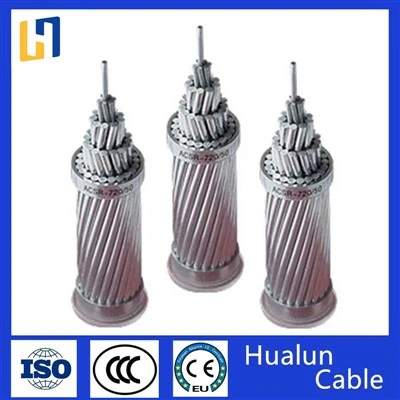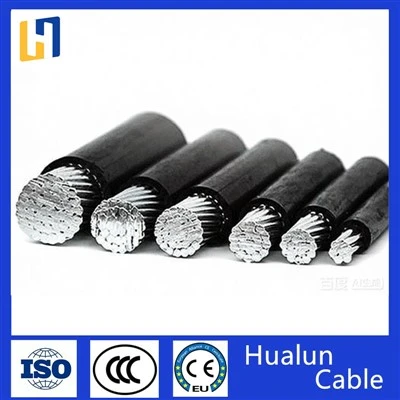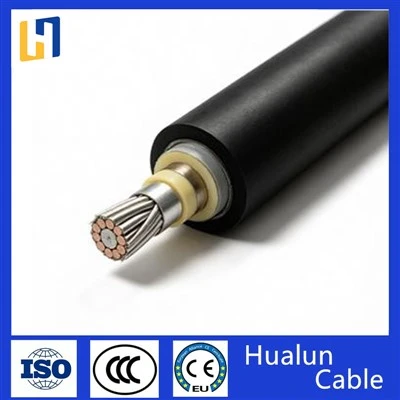

A primary issue with insulated conductors in practical application is their susceptibility to line breakage during lightning strikes. For instance, in 2009, the distribution network in Zhaoqing experienced a total of 1,514 tripping incidents, 751 of which were caused by lightning-accounting for 49.6% of all faults. Between 2007 and 2009, there were 25 instances of overhead insulated lines breaking due to lightning strikes in the city.
Mechanism of Line Breakage
When an insulated conductor is struck by lightning, the resulting overvoltage triggers a flashover across the insulator and punctures the conductor's insulation layer. The insulation material surrounding the puncture point restricts the electric arc from moving rapidly along the conductor's surface, forcing it to remain localized at the point of puncture. The intense heat generated by the power-frequency arc current-which can reach several thousand amperes-concentrates at the puncture site, causing the conductor to melt and break before the circuit breaker can trip. These flashover-induced melting points typically occur within 10 to 30 centimeters of the insulator, as this area features the weakest electric field distribution.
Protective Measures
Strategies to prevent the breakage of overhead insulated conductors due to lightning strikes can be broadly categorized into "blocking" (preventing the strike or its effects) and "diverting" (providing a safe path for the current). Relying on a single protective measure is generally insufficient; therefore, a comprehensive lightning protection strategy must be implemented.
Installing an overhead ground wire (shield wire) primarily serves to convert high-amplitude lightning overvoltages into current, which is then dissipated into the ground through the tower's grounding resistance. This significantly reduces the lightning overvoltage, thereby protecting the conductor. For a 10 kV overhead line, the peak induced voltage can reach 550 kV without an overhead ground wire; the installation of such a wire can reduce this peak induced overvoltage by up to 40%.
Installing gapless, composite-housed zinc-oxide line arresters can limit the amplitude of induced overvoltages. Following a lightning-induced flashover, these arresters absorb discharge energy and prevent the formation of a power-frequency follow-current arc, effectively protecting the insulated conductor. Lightning arresters should be installed on every tension pole (or tower) and branch pole (or tower) to protect the line. For overhead insulated lines, it is recommended that a lightning arrester be installed on a tension pole (or tower) at least once every 500 meters.
Overvoltage protection devices for overhead lines consist of non-linear resistive current-limiting elements (zinc oxide valve blocks) and series discharge gaps (stainless steel arcing rings). When a lightning-induced overvoltage causes a flashover to the ground-resulting in a metallic arc short circuit-the device directs the power-frequency follow current into the non-linear current-limiting element. Leveraging the element's non-linear characteristics, the sinusoidal power-frequency current is transformed into a peaked waveform, causing the arc to extinguish instantaneously. This effectively prevents the overhead insulated conductors from melting due to the high temperatures generated by the power-frequency follow current.
By stripping a small section of the insulation from an insulated conductor-positioned 150 to 200 millimeters from the center of the insulator (on the load side)-and installing arcing-protection fittings, any lightning-induced flashover is forced to occur specifically between the arcing-protection fitting and the steel pin of the insulator. This ensures that the root of the sustained power-frequency short-circuit arc remains fixed on the arcing-protection fitting, thereby protecting the conductor itself from thermal damage.
Given the limited space at the tops of 10 kV overhead line poles, the State Grid Corporation of China has promoted the use of insulated crossarms as a new technology for lightning protection. Utilizing insulated crossarms on tangent (straight-line) poles enhances the line's lightning-withstand capability, ensuring that lightning currents are diverted to ground through metal-oxide lightning arresters located at tension or branch poles, ultimately preventing insulated conductors from being burned or severed.
Safety Warnings for Construction and Operation
During construction, the insulation layer must be strictly protected to avoid any man-made damage. For instance, on May 18, 2023, three workers accidentally abraded the insulation layer of a live 10 kV overhead insulated conductor while pulling the line, which resulted in an electric shock accident. The assessment of potential hazards arising from damaged insulation layers must adhere to relevant regulations, such as the "Operation and Maintenance Regulations for Distribution Networks" (Q/GDW1519-2014) and the "Classification Standards for Equipment Defects in Distribution Networks" (Q/GDW745-2012).