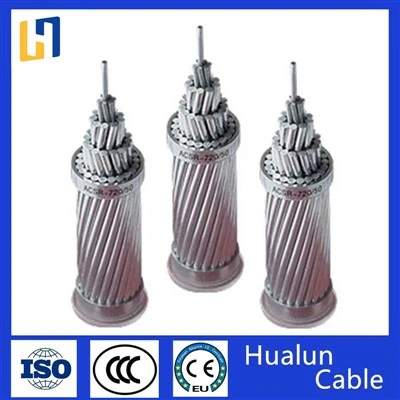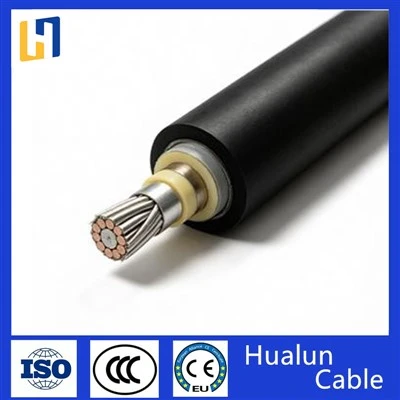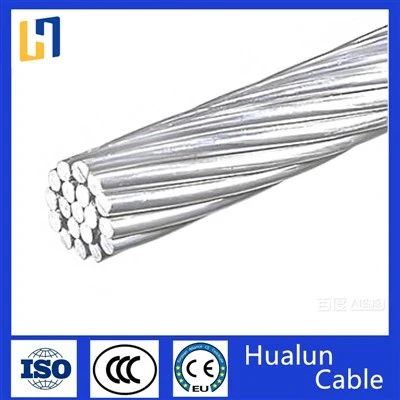

The formula for calculating the linear expansion coefficient of an aluminum conductor steel-reinforced (ACSR) cable is:
α = (αsEs + kαAEA) / (Es + kEA) (1/℃)
Where: αs is the linear expansion coefficient of the steel wire (11.5 × 10⁻⁶ 1/℃);
Es is the elastic modulus of the steel wire (measured average value: 200,900 N/mm²);
αA is the linear expansion coefficient of the aluminum wire (23 × 10⁻⁶ 1/℃);
EA is the elastic modulus of the aluminum wire (measured average value: 65,660 N/mm²);
k is the ratio of the aluminum cross-sectional area to the steel cross-sectional area in the ACSR cable.
Taking the LGJ240/40 specification as an example, its linear expansion coefficient is calculated to be 18.9 × 10⁻⁶ 1/℃. High-capacity (high-ampacity) conductors utilize a design featuring specially heat-resistant aluminum alloy wires. This structure ensures that when the conductor heats up to a certain temperature during operation, the heat-resistant aluminum alloy expands and relaxes, causing the entire tension of the conductor to shift onto the steel core. Consequently, the linear expansion coefficient of such a high-capacity conductor becomes equivalent to that of the steel core-specifically 3.3 × 10⁻⁶ 1/℃-which is significantly lower than 18.9 × 10⁻⁶ 1/℃.